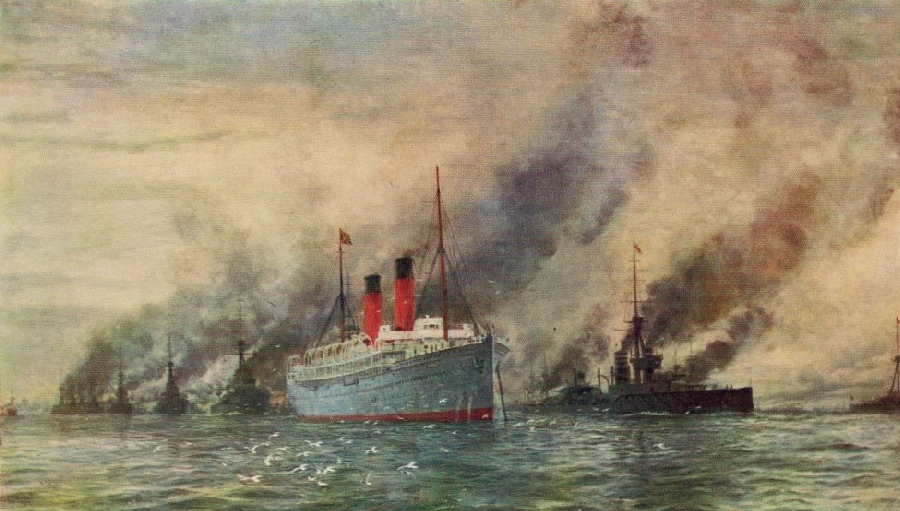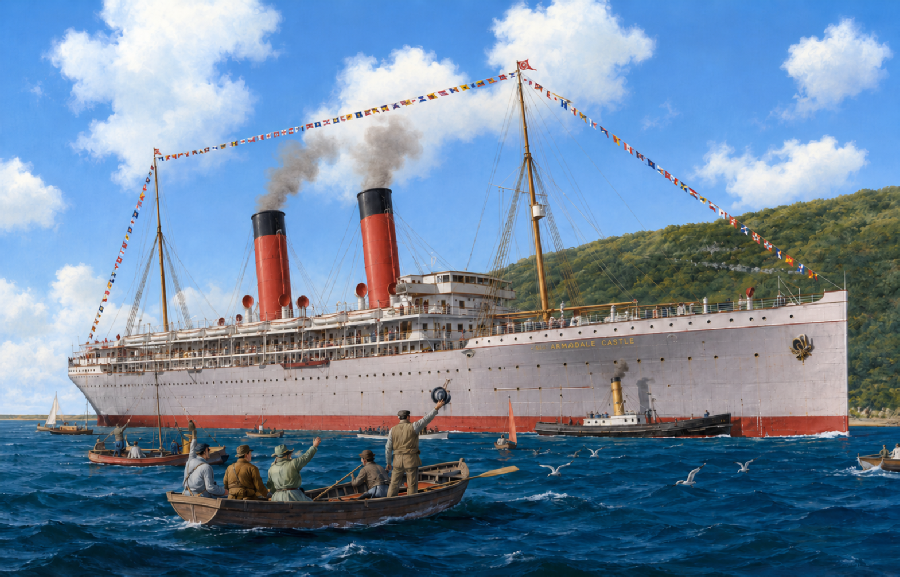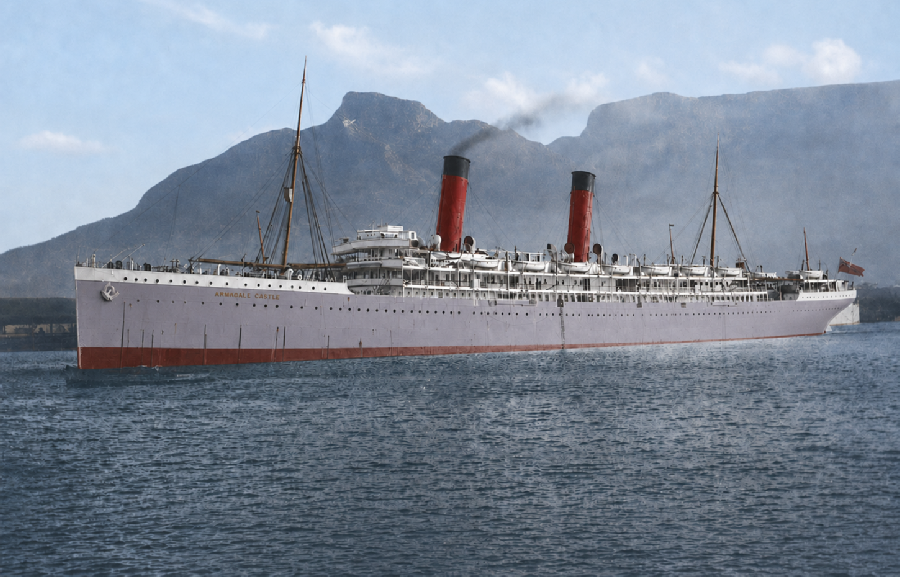
ARMADALE CASTLE (was built in 1903 by Fairfield Shipbuilding and Engineering Co at Glasgow with a tonnage of 12973grt, a length of 570ft 1in, a beam of 64ft 3in and a service speed of 17.5 knots. )

Sister of the Walmer Castle and the first ship to be ordered by Union-Castle she was, in fact, a development of the Union's Saxon.

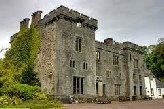
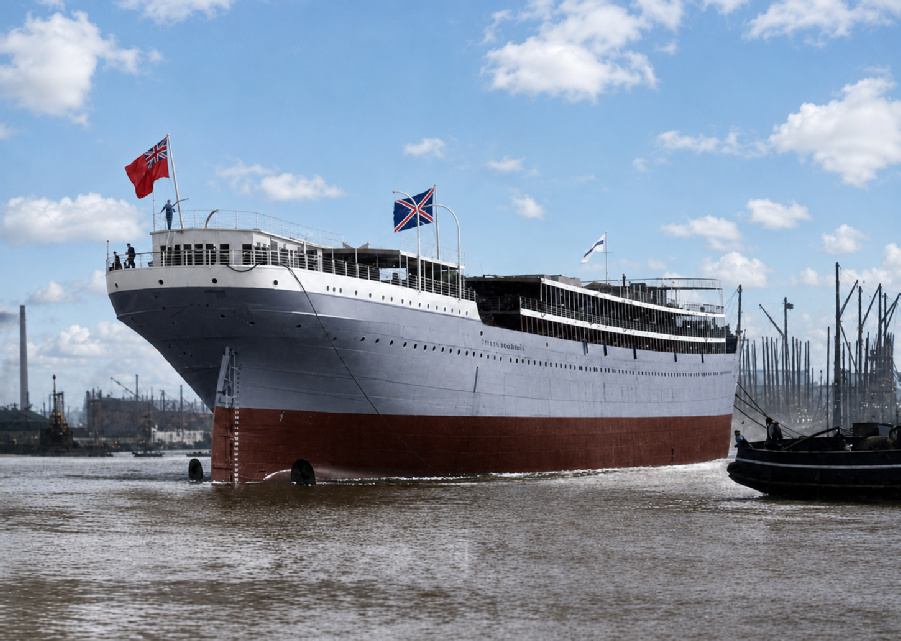
Armadale Castle being the property of the MacDonalds it was fitting that this Cape liner - the first mail steamer built after the Union-Castle amalgamation - should be christened by Lady MacDonald of the Isles.

1903 Deployed to The Cape Mail Service replacing Scot

Making her maiden voyage under the command of the famous Captain J C Robinson, Armadale Castle soon became a favourite and on her third voyage to South Africa in 1904 she achieved fame by crossing the Durban Bar.

For eleven years she ran continuously in the mail service and in July 1914 she brought home the first Governor-General of the Union, Lord Gladstone and his wife.

War was then imminent and even before the outbreak of hostilities she was requisitioned by the Admiralty for use as an auxiliary cruiser becoming HMS Armadale Castle.

1919 Returned to The Cape Mail Service

1936 Scrapped at Blyth

Launch of Armadale Castle - 1903

Master

From

To

J C Robinson

12/1903

6/1906

R Rendall

6/1906

2/1910

J L Stanistreet

11/1908

1/1910

J W Creaghe

2/1910

4/1910

F J Moseley

4/1910

6/1910

J Tyson

6/1910

2/1912

S C Brown

8/1911

10/1911

J L Stanistreet

3/1912

8/1914

G W Armstrong

9/1913

11/1913

Royal Navy

N R Neilson

9/1919

6/1920

L A Millard

6/1921

8/1921

J Culverwell

8/1921

12/1921

H Strong

2/1922

8/1923

J George

8/1923

9/1924

L A Millard

9/1924

6/1925

A S Knight

6/1925

11/1925

L A Millard

11/1925

8/1926

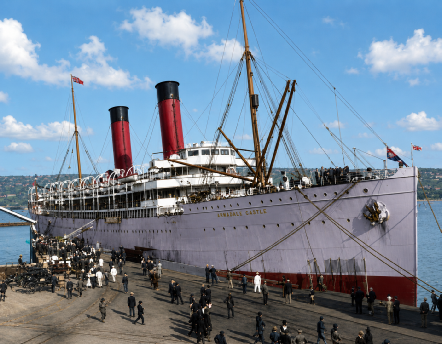
June 26, 1904, was a momentous day in the history of Port Natal. At 1130 am the Armadale Castle, 13,000 tons, with Captain J C Robinson in command, was sighted from the Bluff.

Three tugs went out to meet her, including the Titan, which had on board Mr Robin Wisely, the Durban agent of the Union-Castle Line. The Armadale Castle was at that time among the largest steamers in the world; she was drawing 22½ feet; and she was brought safely alongside ‘E’ Shed at the Point.

That night at a banquet on board the menu bore the following:

Flagship ‘Armadale Castle’

Welcome on board to our friends of Durban to celebrate the  historic occasion of the first Royal Mail Steamer crossing the Bar; and Farewell to the Basket!

Floreat Natalia.

Union-Castle Chronicle by Marischal Murray

From Natal Mercury 25 June 2004

Today marks the 100th anniversary of the day when the first large ship was able to sail into Durban Bay.

The vessel was the Armadale Castle and she docked at E Shed on 26 June 1904.

She was the new flagship of the Union-Castle Line and was 174 meters long and weighed 12976 tons. She was piloted into the harbour by Pilot Jones and escorted by the harbour tugs Harry Escombe and St John and a private tug, Titan, which was owned by the African Shipping Company.

The the docking caused considerable interest with 20,000 people visiting the harbour to see the vessel over the next few days. Her master, Captain J C Robinson, even gave a party for schoolchildren in the town.

The painting used by the Mercury on the front of the supplement was painted in 1994 by Durban artist Benjamin Barnett.

Before 1904 , the entrance to the bay had been blocked by a sandbar which had severely limited the size of ship which could enter it.

The sandbar had been a danger and hindrance to shipping ever since vessels first started calling here. Sporadic efforts were made from the early 1850s to beat the sandbar.

At that time, Scottish Engineer John Milne proposed a solution very similar to that which eventually worked fifty years later.

As chairman of Durban's Harbour Board in 1887, Harry Escombe probably played the major role in initiating efforts to defeat the sandbar.

Harbour Engineers Edward Innes, and later Cathcart Methven, oversaw the dredging of the harbour mouth and the building of piers on either side of it.

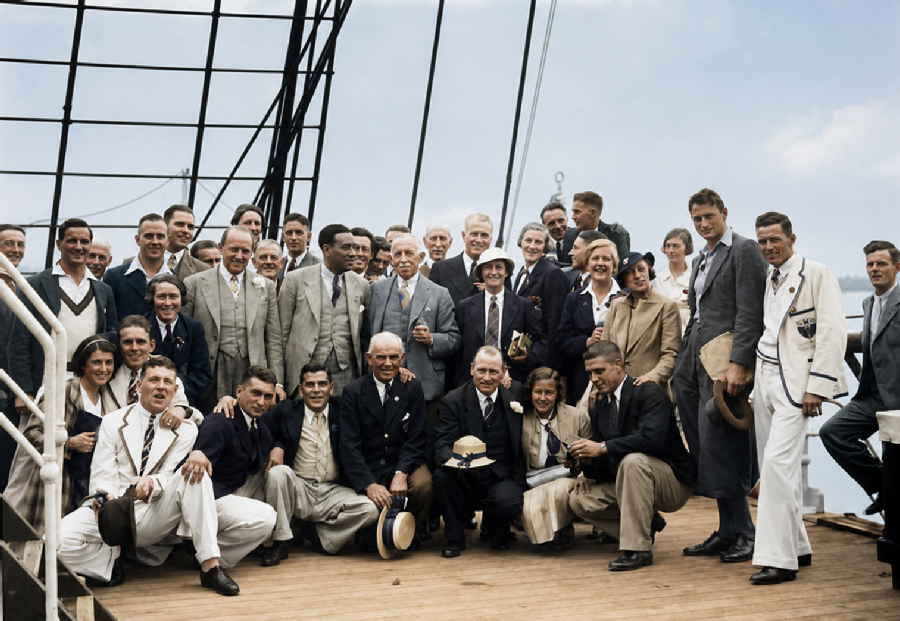
17th August 1934:  South African competitors and officials leaving Southampton on their return from the Empire Games in London

Armadale Castle alongside in Durban

The Opening of Durban Bay to Large Ships - 1904

Encounter with a Giant Fish - December 1904

South African Team for The Empire Games - 1934

Armadale Castle - Art Gallery

Vessel

Built

Tonnage

Official No

Ship Builder

Engine Builder

Engine Type

HP

Screws

Speed

Armadale Castle

1903

12973

118350

Fairfield

Glasgow

2 x Quadruple Expansion Steam

2212 NHP

12000 IHP

2

17.5

Armadale Castle

VJPF

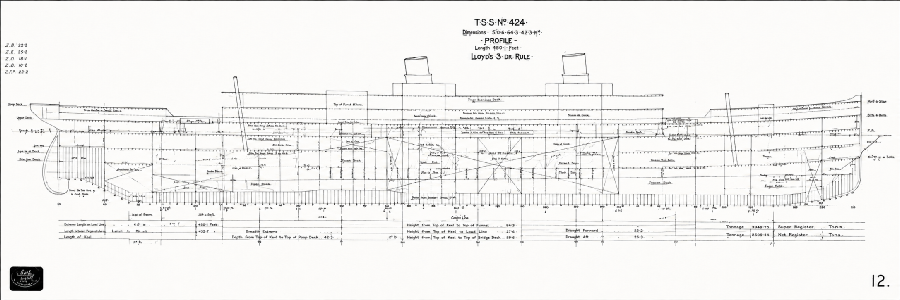
Profile Plan

Master

From

To

A S Knight

8/1926

10/1926

S H Owen

10/1926

9/1927

C B Imlah

3/1927

5/1928

C E Stuart

5/1928

7/1928

Refit

A S Knight

9/1928

5/1929

E A Singeisen

5/1929

7/1929

W S Colbourne

7/1929

9/1929

J H Kerbey

9/1929

11/1929

G J Whitfield

11/1929

6/1931

Refit

H B Harvey

7/1931

3/1932

G J Whitfield

3/1932

7/1932

H B Harvey

7/1932

12/1933

A O Morgan

12/1933

8/1935

E H Thornton

8/1935

10/1935

H L Scholefield

11/1935

4/1936

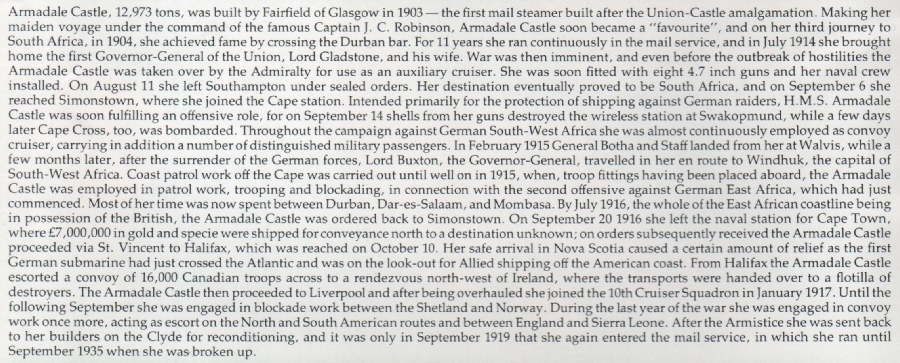
Career Summary

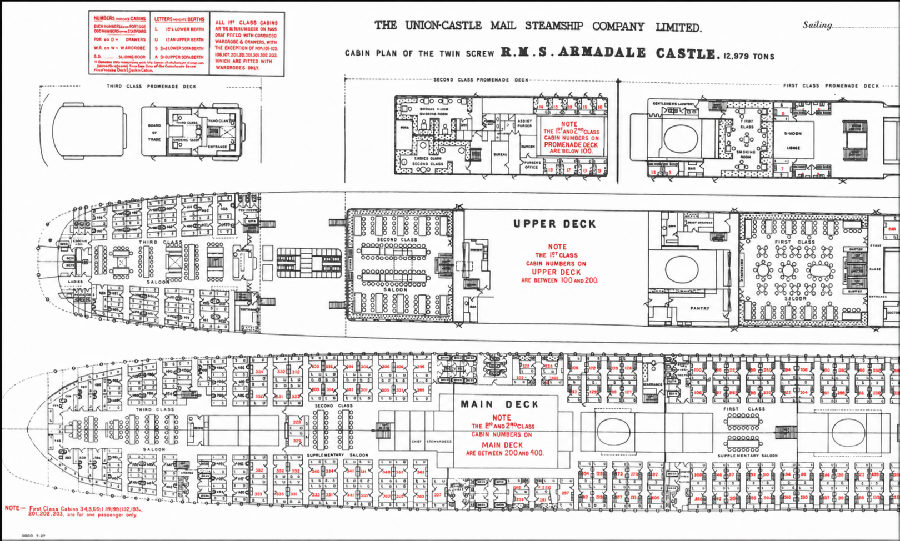
Cabin Plan

“I have one item of news for this voyage,” said Captain N. Allan, of the Aberdeen liner Marathon, when his vessel was boarded by a Melbourne Age representative a couple of weeks ago, “and it comes from Commander J. C. Robinson, of the mail steamship Armadale Castle. Captain Robinson is best known as the ‘missionary’ of the Castle line, and, from his position, may be given credence. This is the captain’s report, as supplied at the Cape, and it really appears that the sea serpent has been met with in reality.”

Under date of 28th December, 1904, Captain J. C. Robinson makes the following statement:—

“On her present voyage out the Armadale Castle met with an interesting experience at 3 p.m. on 20th instant, in lat. 3 deg. south. The ship’s perpendicular stem struck a large fish, which was very likely asleep, behind the pectoral (?) fin, the bend being doubled across the port side, and the body and tail along the starboard side of the bow. The violent struggles of the creature to free itself from its position led to its striking the side with its tail, marking the paint. This was observed by the boatswain and several of the men who were watching on the port side immediately over the tail of the fish. The marks upwards enabled us to make fairly accurate measurements, giving 47 feet to stem, with 8 feet of head and 2 feet of curve, or total of 57 feet. In girth the fish was about the diameter of the ship’s lifeboat, gracefully tapered towards the tail. Owing to the contortions of the body no one could say for certain whether it was mammal or fish. The head was blunt and barrel shaped, and the right eye appeared to be fairly large and protruding. The body was of greeny-brown colour, with large dark spots all over the back and sides, the lower part being of a dull white. A seaman first observed the stranger, and then passengers and crew rushed to the forecastle and witnessed its struggles. Engines were at once stopped and reversed, but it was a quarter of an hour before the fish was freed, when the fish sank slowly, tail first.”

Union-Castle Home Page
Previous Page Next Page
Union-Castle Home Page Home Page